Mantel Decor Ideas That Actually Look Styled (Not Cluttered)

Your mantel is the focal point of your entire living room — and yet most of them end up looking like a shelf at a garage sale. Too many objects, random heights, a mismatched candle collection from three different stores. Sound familiar?
The good news: a styled mantel isn't about spending money. It's about editing. Here's what actually works — and what to get rid of.
The Rule of Odd Numbers (3 or 5 Objects, Never 4)
Designers use this one religiously. Groups of odd numbers — 3 or 5 — look dynamic and intentional. Even numbers feel static and symmetrical in a way that reads as corporate rather than cozy.
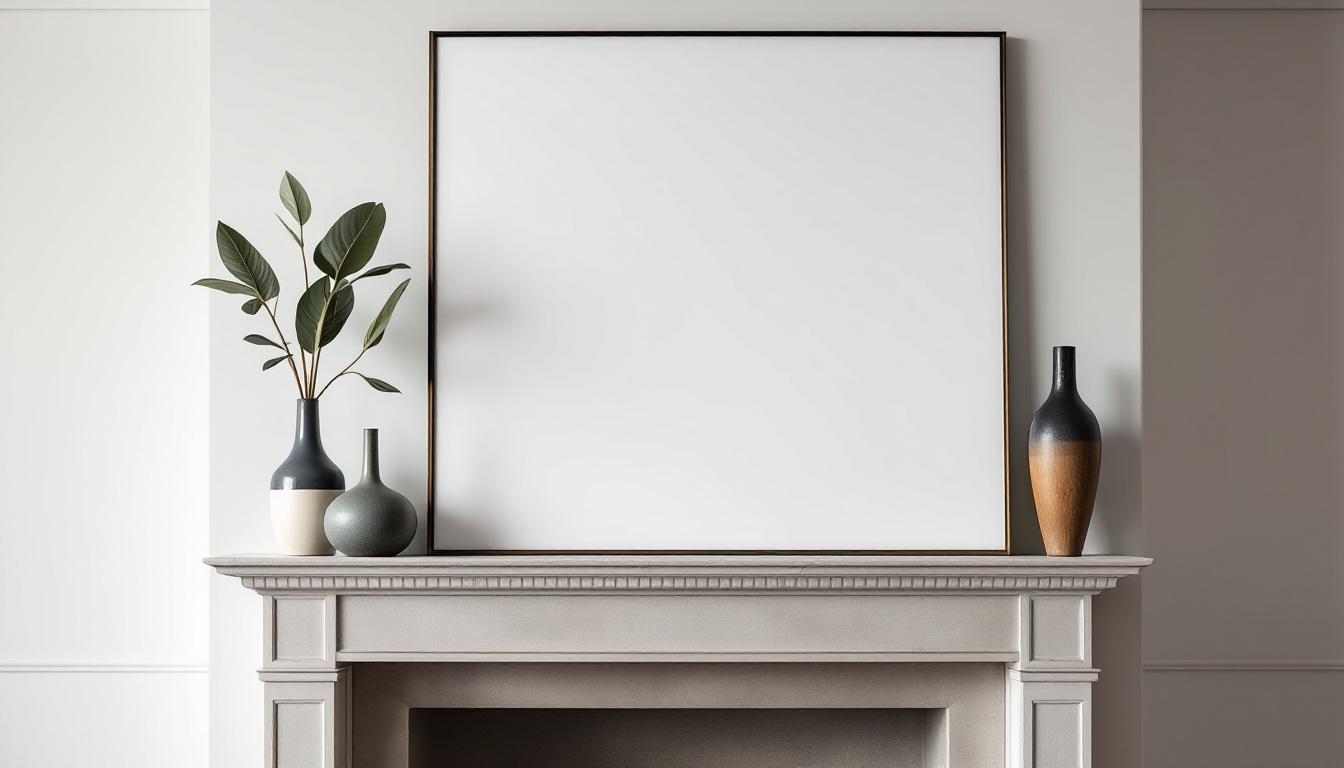
Pick 3 or 5 objects for your mantel. That might be a tall vase, a medium sculpture, and a small stack of books. Or a large mirror, two candlesticks, a small plant, a lantern, and a framed photo. Count your objects before you put them up — if you have 6, put one back.
Varied heights are just as important as the odd count. Your eye needs somewhere to travel. Line up three objects all the same height and your mantel looks flat. Vary them — tall in the back or side, medium in the middle, short as a bookend. That variation creates movement.

The Anchor Piece: Your Large Mirror or Artwork
Every great mantel has one anchor — a large piece that everything else responds to. Usually this is a mirror or a piece of artwork. The sizing rule: your anchor piece should cover roughly two-thirds of the mantel width. Go smaller and it floats. Go wider and it overwhelms.
Mirrors are particularly smart for mantels because they bounce light, make the room feel larger, and work with literally any decor style. An arched mirror in warm brass or matte black costs $80–300 and transforms the whole wall. If you go with art instead, choose something with at least 2 of the colors already in your room.
Lean it, don't hang it. Leaning your anchor piece against the wall gives you flexibility to rearrange without patching holes — and it looks intentionally casual, which is exactly the vibe most people are going for right now.

The Layering Technique: Overlap for Depth
Layering is what separates a styled mantel from a lined-up mantel. Instead of placing each object with a gap between them, you let things overlap slightly. Lean a small frame in front of your large mirror. Place a short candle in front of a taller vase. Stack a book horizontally and set a small object on top.
This overlapping creates foreground, middle ground, and background — which is the same principle photographers and painters use to make a flat surface look three-dimensional. The moment you add even one layer of depth, your mantel stops looking like a display shelf and starts looking like a curated vignette.
You can also layer textures. Rough terracotta next to smooth marble next to soft woven linen. The contrast in texture adds visual interest even if you're working in an almost monochromatic color palette.

Seasonal Rotation: Change 2–3 Pieces, Not Everything
The trick to a mantel that always looks fresh is having a permanent base and rotating a few seasonal elements. Your base might be the mirror, a large sculptural vase, and a stack of art books. Those stay year-round.
Then you swap out 2–3 pieces with the season. In fall: a small pumpkin, dried wheat stems, warm amber candles. In winter: a small wreath, pinecones, white taper candles. In spring: fresh tulips or a small potted plant, pastel ceramic. In summer: a shell or driftwood, linen-wrapped candles, a small succulent.
Keep a box in a closet with your seasonal swap items. Budget $20–50 per season for fresh elements — dried stems and small ceramics are cheap and last multiple years. You don't need to spend much to make the whole room feel like it changed.
What NOT to Put on Your Mantel
This section might sting a little, but it's worth it. Here are the most common mantel mistakes:
Too many family photos. One or two framed photos can work as personal touches. But when the mantel becomes a photo wall, it loses its design impact entirely. Move your family photos to a gallery wall in the hallway instead.
Matching candlestick sets. A perfect pair of identical candlesticks from a big-box store reads as unoriginal. Instead, mix similar but different — two candlesticks of different heights in the same metal finish, or similar shapes in different materials.
Fake flowers. Silk or plastic flowers almost always look cheap regardless of how expensive they were. If you want botanicals, go for dried flowers, dried pampas grass, or dried eucalyptus — they're actually trendy, they smell faintly nice, and they last all year without watering.
Random tchotchkes. The small decorative items you've accumulated over the years — vacation souvenirs, gift shop animals, a random bowl of shells — belong in a different room or a drawer. Your mantel needs intentional pieces, not storage overflow.
Scale Matters: The 1/3 to 2/3 Height Rule
Once you've got your anchor mirror or artwork in place, all your other objects should fall between one-third and two-thirds of that anchor's height. Shorter than one-third and they'll look lost. Taller than two-thirds and they'll compete with the anchor for attention.
If your mirror is 36 inches tall, your objects should be between 12 and 24 inches. That's your working range. A 28-inch vase is too tall — it'll look like it's trying to be the anchor. A 4-inch tealight is too short unless it's paired with other items to create a layered vignette.
Color Cohesion: 2–3 Colors Max
Pick two or three colors from your room's existing palette and repeat them on the mantel. If your sofa has warm tan cushions and your rug has rust and cream, bring a rust ceramic vase, a cream candle, and a natural wood object onto the mantel. That repetition creates visual cohesion — the mantel feels like it belongs there.
Neutrals count as a color — so white, cream, beige, and natural wood can be your foundation with one pop color as your accent. You don't need to match exactly; you need to rhyme. A dark green vase doesn't have to match your olive throw pillow exactly — similar family is enough.
Empty Space Is Not Wasted Space
This might be the hardest concept to get comfortable with: leaving parts of your mantel empty on purpose. Negative space — the blank shelf between objects — gives your eye a place to rest and makes each object you DO display more significant.
A mantel with objects only on the left two-thirds, leaving the right third completely empty, often looks more intentional than one that's filled corner to corner. Resist the urge to fill every inch. Some of the best-styled mantels in design magazines are 40% empty shelf.
Start by pulling everything off your mantel. Then add back only the pieces you truly love — and stop before it feels full. That slightly-too-empty feeling when you stop? That's probably about right.
Frequently Asked Questions
How many items should be on a mantel? Aim for 3 to 5 objects total. Odd numbers look more natural and dynamic than even groupings. Quality and intentionality matter more than quantity.
What size mirror should I put above a fireplace? Your mirror should be roughly two-thirds the width of your mantel shelf. For a 60-inch mantel, that's around 36–40 inches wide. Height-wise, aim for 30–40 inches so it doesn't get lost above the firebox.
Can I put a TV above my fireplace mantel? You can, but it's not ideal. The heat and viewing angle are the main problems — you'd be looking up at a steep angle. If you do it, keep the mantel styling minimal since the TV dominates. A large piece of art on the mantel is a much better focal point.
How do I style a mantel without a fireplace? The same rules apply. If you have a decorative mantel or shelf without a working fireplace, you can use the firebox opening to display stacked books, a cluster of candles, or a large vase with dried branches.
What's the most common mantel decorating mistake? Overcrowding. Most people put too much on the mantel and end up with a cluttered shelf instead of a styled vignette. When in doubt, remove one more item than feels comfortable. You can always add back.