Kitchen Island Decor: How to Style the Centerpiece of Your Kitchen
The kitchen island is the room's centerpiece, its social hub, and — if you're not careful — its biggest clutter magnet. Styling it well means balancing three things: it needs to look good, function as prep space, and not accumulate the pile of mail and random objects that somehow migrates to every horizontal surface. This guide gives you a practical framework for kitchen island decor that actually holds up in daily life, with real measurements and costs included.
Pendant Lighting: The One Rule Most People Get Wrong
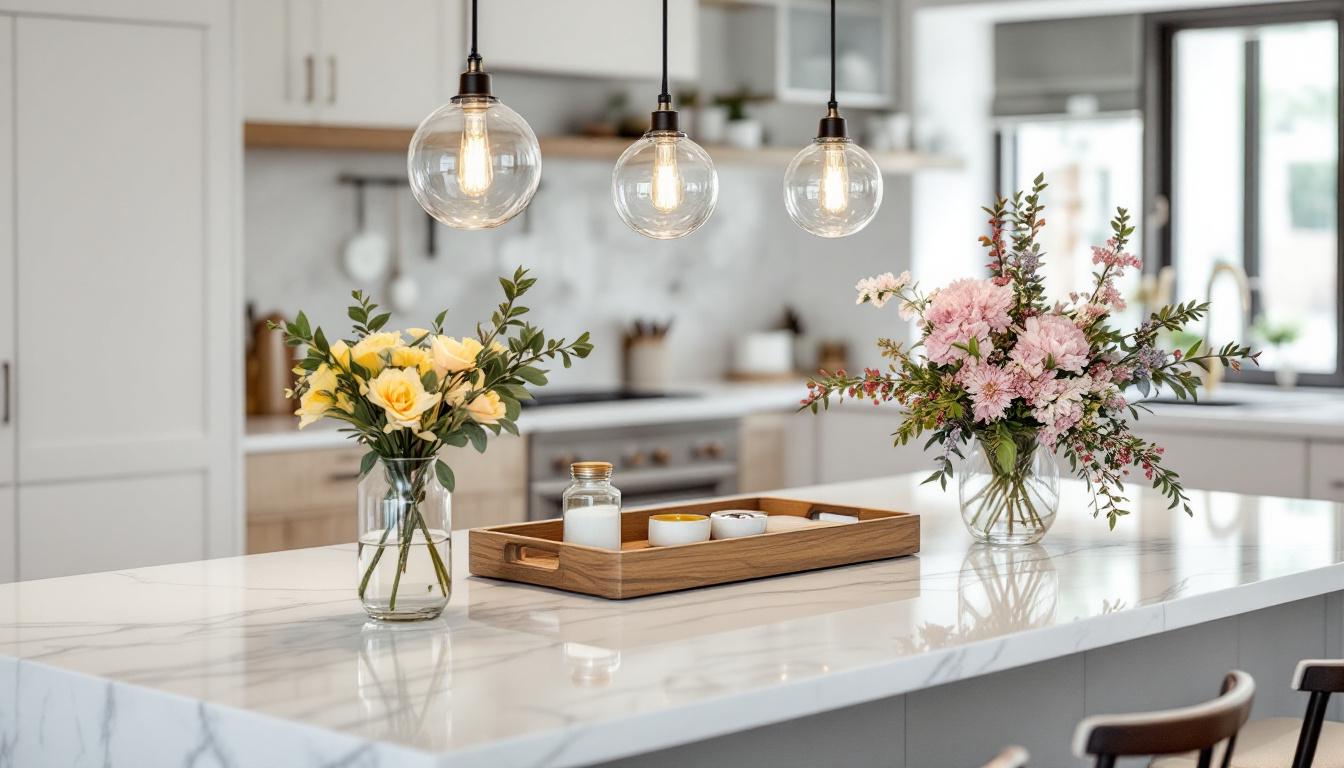
Pendant lights over the island are one of the most impactful design decisions in a kitchen — and one of the most commonly installed wrong. The two mistakes: hanging them too high, and using only one pendant for a long island. For a standard 6–8 foot island, two or three pendants spaced evenly is the right number. A single pendant centered over a long island looks like an afterthought. Three pendants over a shorter 4-foot island feels cluttered. Match the number to the length: roughly one pendant per 2 feet of island is a reasonable starting point. Height matters enormously. The bottom of the pendant should hang 30–36 inches above the countertop surface. Lower than 30 inches and people will bump their heads. Higher than 36 inches and the fixtures lose their intimacy with the surface — they just float up near the ceiling and lose visual connection to the island. For scale: if your ceilings are 9 feet or higher, you can go taller (up to 40 inches above counter) and use a larger fixture. If you're working with 8-foot ceilings, stay at 30–34 inches and choose smaller pendants so the space doesn't feel crowded overhead. Budget: $50–$150 per pendant gets you solid mid-range options from West Elm, CB2, or Amazon. $150–$300 moves into statement pieces. Anything above $300 per fixture is specialty — worth it for a showpiece kitchen, overkill for most.

Countertop Styling: Curated, Not Cluttered
The goal with countertop styling is to make the island look like someone thought about it — not like things just landed there. Three elements that do this reliably: a tray, a focal point object, and a living element. A tray (wood, marble, rattan — whatever matches your kitchen's material palette) corrals smaller items. It's a visual container that makes a cluster of objects read as a vignette instead of a pile. On the tray: a small candle, a salt cellar, a small succulent. Off the tray: nothing that doesn't belong. The focal point object is one thing that draws the eye — a fruit bowl with actual fruit in it (and you have to actually use it, otherwise it becomes a prop that collects dust), a generous cookbook propped open on a stand, or a small potted herb. It should be at least 10–12 inches tall to have presence on a 36-inch counter. A cookbook stand serves double duty: it's functional (keeps your recipe visible while cooking) and decorative (a beautiful cookbook spine is genuinely nice to look at). Budget $25–$80 for a solid acrylic or metal stand.

Island Seating: Getting the Heights Right
Getting seating wrong is one of the most common (and expensive) mistakes in kitchen design. The rule is simple: the stool or chair seat needs to be 9–12 inches below the counter surface. Standard kitchen island height is 36 inches (counter height). For a 36-inch counter, you want bar stools with a seat height of 24–26 inches. Counter-height islands at 42 inches take counter stools with a seat height of 28–30 inches. Before you buy, measure your island. Manufacturers don't always agree on what "bar height" means. Check the actual seat height number, not the marketing label. For style: backless stools slide fully under the island when not in use, keeping the space looking neat. Backed stools are more comfortable for longer sitting but protrude more. If your island is in a tight kitchen, backless wins for the visual breathing room. Budget: $100–$200 per stool for solid mid-range (IKEA Dalfred, west elm Saddle, Target Threshold stools). $200–$400 moves into upholstered or leather options. Buy the same model for all your stools — mixing works in some contexts, but matched stools are the reliable choice.

Seasonal Centerpieces: How to Refresh Without Redecorating
The island centerpiece is the easiest thing to swap seasonally without touching anything else. In spring and summer: fresh flowers in a simple vase (grocery store tulips or sunflowers do more design work than most people give them credit for) or a bowl of bright citrus. In fall: small gourds, a wooden bowl of pomegranates, or a potted chrysanthemum. In winter: evergreen branches, pinecones, a simple candle arrangement. Herb pots are another underrated option that's good year-round: a pot of basil, rosemary, or mint on the island is functional (you actually use it while cooking), living (adds organic texture), and fragrant (good for the kitchen). Keep it in a beautiful pot — terracotta, matte ceramic, or woven rattan sleeve — not the plastic nursery container it came in.

Functional Decor: When Useful Things Also Look Good
Not everything on your island has to be purely decorative — some functional objects belong on the counter. The key is choosing versions that look intentional. A paper towel holder: brass or matte black, wall-mounted or freestanding with clean lines. A utensil crock for frequently used tools: ceramic, concrete, or a natural material rather than plastic. A knife block: if you want it on the counter, get a good-looking one (bamboo, magnetic strip mounted on the wall, or a solid wood block). The guideline: if an object lives on your island counter every day, it earns its place. If it's only used occasionally, find it a home in a drawer or cabinet. Every object on the counter is a design choice, even if you didn't mean it to be. Treat each one like a decision.
What to Keep Off the Island
This is the hardest part of island styling, because the island is large, central, and horizontal — which means everything gravitates toward it. Mail goes there. Keys go there. Kids' backpacks go there. Half-finished projects go there. Fighting this is a habit issue as much as a design issue, but the design can help. Dedicate one drawer or a small basket near the entrance for keys and daily drop items. Put a small mail organizer somewhere that isn't the kitchen. Give kids a hook and hook them on using it. The island is first and foremost prep space. Every time it's covered in stuff, someone has to clear it before they can cook. That friction adds up fast. Keep the counter clear of appliances you don't use daily — the stand mixer, the bread maker, the air fryer that only comes out on weekends. They go in a cabinet. The visual payoff of a clear counter is significant.
Under-Island Storage: The Space Most People Ignore
If your island has open shelving on one or both ends (rather than closed cabinets all the way around), that space is valuable and visible — which means it has to be styled as well as organized. Open shelves on an island are ideal for cookbooks (stood upright, spines facing out), a wine rack (built-in or a freestanding insert), or woven baskets that corral less photogenic items. Baskets on open island shelves are a smart trick: they hide the stuff you need to access (extra napkins, plastic bags, miscellaneous kitchen items) while reading as textured, intentional decor from a distance. Choose natural materials — seagrass, jute, water hyacinth — that complement a wood or stone counter above.
Waterfall Edge: When It's Worth It
A waterfall edge is when the countertop material continues down the side of the island to the floor, creating a continuous slab effect. It makes the island look like a piece of furniture rather than a built-in — it's a strong visual statement. Cost: $500–$2,000 extra depending on the material and how many sides you do. Quartz waterfall edges are the most popular because the material doesn't have directional grain — the pattern can be mirrored to continue seamlessly. Natural stone is more dramatic but requires careful book-matching to look right. Is it worth it? If your island is a statement piece and you're investing in quality countertop material, yes. If your kitchen is more casual and your countertops are a mid-range laminate, a waterfall edge doesn't add the same visual value. It's a premium move for a kitchen that's already heading in a premium direction.
Frequently Asked Questions
How many pendants should I hang over my kitchen island?
One pendant per 2 feet of island is a reliable rule. A 6-foot island takes 2–3 pendants. A 4-foot island takes 1–2. Space them evenly and center the group over the island, not just the ceiling box.
What height bar stool do I need for a kitchen island?
Measure your counter height first. For a 36-inch counter (standard kitchen height), choose stools with a seat height of 24–26 inches. For a 42-inch counter (bar height), choose 28–30 inch seat height. Always verify the actual seat height number rather than relying on "bar" or "counter" labels.
What should I put on my kitchen island?
Keep it minimal and intentional: a tray with 2–3 small items, one larger focal piece (fruit bowl, herb pot, vase), and functional items you use daily (utensil crock, paper towel holder). Everything else should be in a drawer or cabinet. The island is prep space first.
How high should pendant lights hang over a kitchen island?
The bottom of the pendant should hang 30–36 inches above the countertop surface. In kitchens with higher ceilings (9+ feet), you can go up to 40 inches above the counter. Below 30 inches and people start bumping their heads.
Is a waterfall edge on a kitchen island worth the cost?
If your kitchen is already investing in quality materials and you want the island to feel like a furniture piece, yes — $500–$2,000 for the extra stone or quartz can significantly elevate the space. It's less worthwhile on a budget kitchen where the material itself doesn't warrant the showcase treatment.
A well-styled kitchen island makes your whole kitchen feel more designed — even if nothing else changes. Start with the pendants (get the height right), then seating (measure first, buy second), then add a simple countertop vignette and commit to keeping the rest clear. If you want to see what different pendant styles, countertop materials, or stool options would look like in your actual kitchen before making any purchases, upload a photo to StableRender and get a photorealistic preview in under a minute.